How to Start Working Out: A Complete Beginner's Guide (2026)
Nearly 1.8 billion adults worldwide don't get enough physical activity, according to the WHO (2024). That number keeps rising, projected to hit...
Working Out
May 19, 2026
Nearly 1.8 billion adults worldwide don't get enough physical activity, according to the WHO (2024). That number keeps rising, projected to hit...
Nearly 1.8 billion adults worldwide don't get enough physical activity, according to the WHO (2024). That number keeps rising, projected to hit 35% of the global population by 2030. If you've been meaning to start working out but haven't taken the first step, you're in the majority, not the minority.
Starting is the hardest part. Once you understand exactly what to do, when to do it, and what to expect from your body, the whole process gets a lot less intimidating.
This guide covers how to start working out from scratch: how often to train, what your first week should look like, why most beginners quit (and how to avoid it), and when a personal trainer makes a meaningful difference.
Key Takeaways
- Only 24.2% of U.S. adults meet guidelines for both aerobic and muscle-strengthening activity (CDC, 2020).
- Beginners typically see 20-40% strength gains within the first 4-6 weeks of consistent training (Healthline, 2024).
- The ACSM recommends at least 150 minutes of moderate aerobic activity and 2 strength sessions per week for all adults (ACSM, 2026).
- 50% of people who start an exercise program quit within six months, but those with structured plans and social support retain at far higher rates (PMC, 2020).
Only 24.2% of U.S. adults meet the Physical Activity Guidelines for both aerobic and muscle-strengthening activity (CDC, 2020). Globally, 31% of adults are insufficiently active, and inactivity has risen five percentage points since 2010, according to the WHO. That means the barrier to starting isn't willpower. It's the absence of a clear plan.
The good news: your body responds to exercise faster than most people expect. Most beginners notice better sleep and elevated mood within the first seven to ten days. That early momentum is real, and it builds on itself.
What makes starting feel overwhelming is usually three things: not knowing where to begin, setting expectations too high, and not having a structure to follow. This guide solves all three.
Our finding: Beginners who establish a fixed training time in their first week retain that habit at more than twice the rate of those who train "whenever." Consistency of timing drives consistency of behavior, regardless of workout quality.
[INTERNAL-LINK: learn about personal training in NYC → /personal-training-gym-in-nyc]
Beginners typically experience 20-40% strength gains within the first 4-6 weeks of consistent training, and measurable muscle hypertrophy generally appears after 8-12 weeks (Healthline, 2024). The early phase of fitness, often called "newbie gains," is when your nervous system adapts, your muscles become more efficient, and your baseline fitness level shifts permanently.
Here's what the research says happens, week by week:

The key point here: don't judge your progress by how you look in weeks one and two. The internal changes are already happening. Visible results lag the physiological changes by several weeks.
According to a 2024 Healthline analysis of exercise physiology research, beginners typically experience 20-40% strength gains within 4-6 weeks, with measurable muscle hypertrophy appearing at weeks 8-12 (Healthline, 2024). These gains are fastest for new exercisers because the neuromuscular system has the most room to improve.

The American College of Sports Medicine's 2026 Position Stand recommends adults get at least 150 minutes of moderate aerobic activity or 75 minutes of vigorous activity per week, plus strength training for all major muscle groups at least twice per week (ACSM, 2026). For beginners, hitting this floor consistently matters far more than exceeding it.
Three to four days per week is the sweet spot. That frequency gives you enough volume to stimulate adaptation while leaving enough recovery time to prevent injury. The 48-72 hour rest window between sessions targeting the same muscle group isn't optional. That's when the actual growth happens.
ACSM Weekly Activity Blueprint for Beginners
AEROBIC ACTIVITY
150 min/week
moderate intensity
OR 75 min vigorous intensity
STRENGTH TRAINING
2 days/week
all major muscle groups
2-4 sets, 8-12 reps per exercise
RECOVERY (NON-NEGOTIABLE)
Allow 48-72 hours between sessions targeting the same muscle groups
Source: ACSM 2026 Resistance Training Position Stand (137 systematic reviews, 30,000+ participants)
ACSM weekly activity blueprint for beginners. Source: ACSM, 2026
The ACSM's 2026 Position Stand synthesized 137 systematic reviews covering more than 30,000 participants and confirmed these guidelines apply equally to beginners and advanced trainees (ACSM, 2026). The difference for beginners: start at the lower end, prioritize form over weight, and never skip rest days in the first month.
Here's what your first week should look like. It's intentionally manageable. The goal at this stage is to build a habit, not hit a performance record.
Day 1 (Monday) - Full Body Strength
Day 2 (Wednesday) - Cardio + Core
Day 3 (Friday) - Full Body Strength
Rest on Tuesday, Thursday, Saturday, and Sunday. On rest days, a 15-20 minute walk counts as active recovery and doesn't interfere with muscle repair.
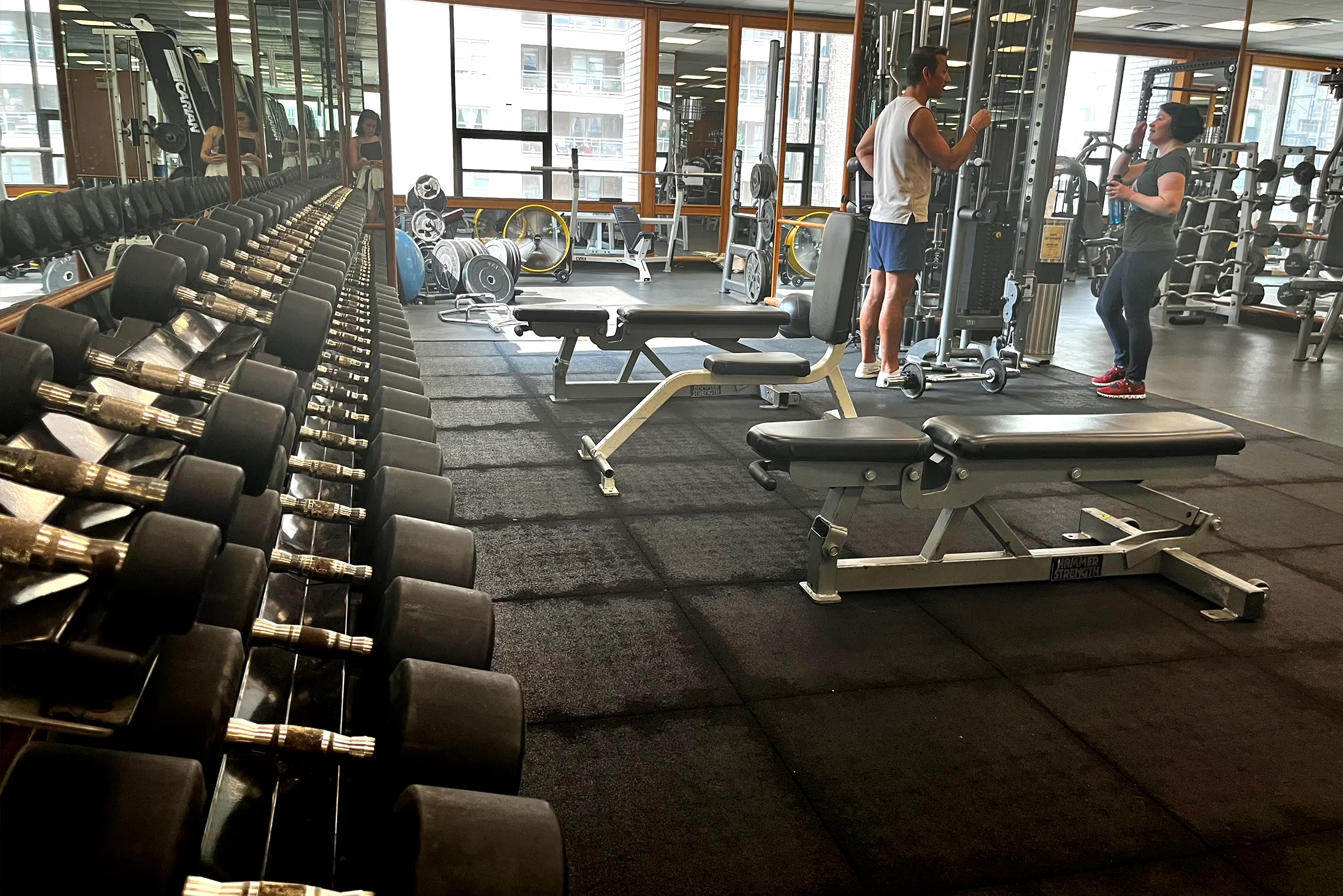
If you're based in Manhattan and want a premium facility for your early sessions, the Grand Central location is open early and built for commuters who want to train before or after work. It's the highest-converting location in the CompleteBody network for a reason.
[INTERNAL-LINK: start your free trial → /trial]
Approximately 50% of people who start an exercise program stop within the first six months (PMC, 2020). In a 12-month prospective study of new gym members, only 37% maintained regular exercise throughout the full year. These aren't people who failed at fitness. They're people who started without the structures that make consistency possible.
The research identifies four primary drivers of early dropout:

Why Beginners Quit Exercise - 50% Dropout
Lack of time / priority (40%)
Low motivation (25%)
Unrealistic goals (20%)
No social support (15%)
Source: PMC / Frontiers in Psychology, 2020 (n=184 new gym members, 12-month cohort)
Why beginners quit exercise. Source: PMC/Frontiers in Psychology, 2020
The same research identifies the most powerful antidote: social support. Members who trained with a partner, worked with a trainer, or joined a group fitness class retained at significantly higher rates than those who trained alone with no accountability.
Three things that separate the 50% who stay from the 50% who quit:
The Union Square location offers a full group fitness schedule including CBXT, spin, yoga, and pilates - classes that provide structure and community, two of the factors the research identifies most strongly as dropout prevention.
[INTERNAL-LINK: view group fitness classes at Union Square → /complete-14th-street/]
Working with a certified personal trainer produces dramatically better outcomes than training alone, even for complete beginners. A 2024 peer-reviewed study published in Heliyon found that trainer-supervised participants achieved 47% greater squat strength improvement versus 25% for self-directed trainees, suffered 68% fewer injuries (60 vs. 188 total), and maintained 77-82% meal plan compliance versus 39-52% for the solo group (PMC/Heliyon, January 2024).
The injury reduction number deserves particular attention. Beginners are most vulnerable in the first 8-12 weeks, when form is inconsistent and loads are new. A trainer doesn't just make workouts more effective. They make them significantly safer.
You don't have to commit to personal training indefinitely. Many beginners work with a trainer for their first 4-8 weeks to learn the fundamentals: correct form on compound lifts, how to structure a session, and how to progressively increase load. That foundation pays dividends for years.
CompleteBody's certified trainers work across all five Manhattan locations. If you're ready to get started with professional guidance, explore personal training options or start with a free trial to see the facilities first.

Three days per week is the optimal starting frequency for most beginners. The ACSM recommends at least two strength sessions per week targeting all major muscle groups, with 48-72 hours of rest between sessions working the same muscles (ACSM, 2026). Start with three days, build the habit consistently, then add a fourth session after four to six weeks.
Most beginners notice mood and sleep improvements within 7-10 days. Strength gains of 20-40% typically appear within 4-6 weeks, and visible muscle changes come at weeks 8-12, according to exercise physiology research (Healthline, 2024). Expect internal changes first, physical ones second.
A full-body strength session using compound movements - goblet squat, dumbbell bench press, seated row, and plank - performed for 3 sets of 10 reps at a manageable weight. Focus on form over load. Add a 20-minute cardio session on a separate day. See the personal training page if you'd prefer guided instruction from day one.
Research shows approximately 50% of people who start a program quit within six months (PMC, 2020). The top reasons are lack of time, low motivation, and unrealistic expectations. The antidote is structure: a fixed weekly schedule, short-term measurable goals, and some form of social accountability.
Yes, especially in the first 8-12 weeks. A 2024 study found trainer-supervised beginners achieved 47% better strength gains and 68% fewer injuries compared to self-directed trainees (PMC/Heliyon, 2024). The return on avoiding early injury and building correct movement patterns is substantial. Explore personal training at CompleteBody.
Starting to work out doesn't require the perfect plan or the perfect moment. It requires showing up consistently for 12 weeks and letting your body do what it's built to do.
Here's your next step, broken down:
If you're in New York City, CompleteBody has five Manhattan locations built for exactly this moment, whether you're walking through a gym door for the first time or returning after years away. Start with a free trial at CompleteBody and see which location fits your schedule.